Introduction
The coaching landscape in India has undergone a seismic shift over the last few years. What began as a forced digital adoption during the global pandemic has now matured into a strategic crossroads for academic directors. Today, coaching institute owners are no longer asking if they should go digital, but rather to what extent.
For high-stakes exams like NEET, where every mark can determine a student’s future, the choice between a Learning Management System and the traditional classroom model is critical. Each system offers distinct advantages, but as the NEET coaching system evolves, the decision-making process must be driven by data and student outcomes.
What is a Traditional Classroom Model?
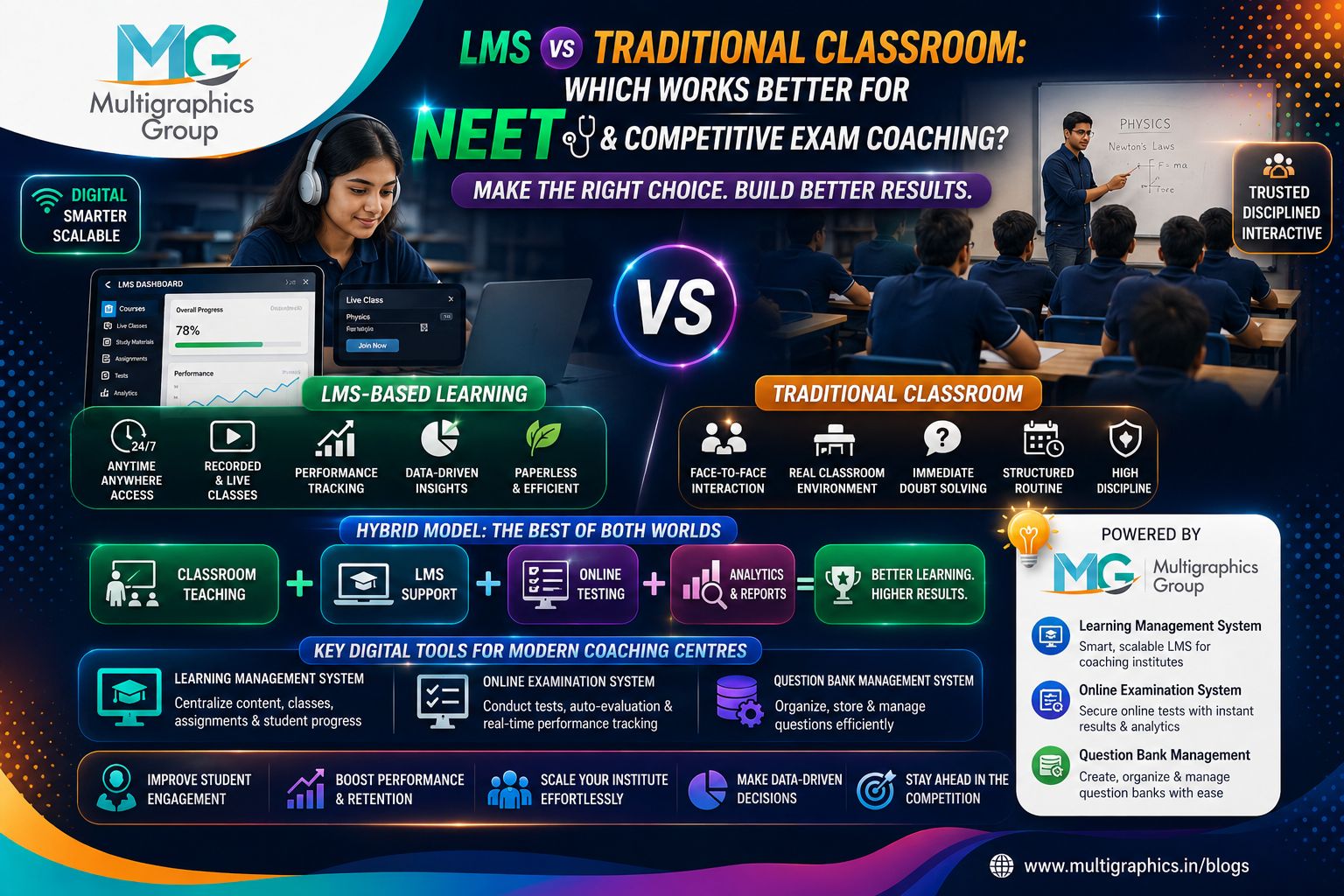
The traditional classroom has been the gold standard for competitive exam preparation for decades. Its effectiveness is rooted in its simplicity and human-centric approach:
-
✔
Offline Teaching
Subject matter experts deliver lectures in physical classrooms, allowing for real-time clarification of complex concepts.
-
✔
Physical Interaction
Direct eye contact and body language cues help teachers assess student engagement and adjust their pace accordingly.
-
✔
Paper-Based Testing
Assessments are typically conducted using OMR sheets and question booklets, mirroring the actual NEET exam format.
-
✔
Social Learning
Students thrive in a competitive peer environment that fosters healthy rivalry and collaborative problem-solving.
What is an LMS-Based Learning System?
An LMS represents a centralised digital hub that manages the entire academic lifecycle. It is designed to extend learning beyond the four walls of a classroom:
-
✔
Digital Content Delivery
Recorded lectures, PDFs, and interactive modules are available 24/7, allowing for personalised revision.
-
✔
Online Tracking
The system monitors every student’s progress, from video watch time to quiz performance, providing instant feedback.
-
✔
Centralised Learning
All study materials, schedules, and notifications are stored in one place, reducing administrative clutter.
-
✔
Asynchronous Learning
Students can learn at their own pace, re-watching difficult physics derivations or chemistry mechanisms until they achieve mastery.
LMS vs Traditional Classroom: A Strategic Comparison
For a NEET coaching system, the comparison must be viewed through the lens of scalability and performance tracking.
| Content Delivery | Fixed schedule, physical presence | Anytime, anywhere access |
|---|---|---|
| Student Engagement | High (immediate feedback) | Variable (requires self-discipline) |
| Accessibility | Limited by geography | Boundary-less (Scalable) |
| Performance Tracking | Manual & Periodic | Real-time & Continuous |
| Scalability | High infrastructure cost | Low marginal cost for new students |
| Cost Efficiency | High overheads (Rent/Electricity) | Initial tech investment, long-term ROI |
Advantages of Traditional Coaching
Despite the digital surge, traditional coaching remains a powerful force in digital vs offline coaching debates:
Face-to-Face Interaction: The psychological impact of a mentor’s presence cannot be replicated by a screen. It builds trust and emotional resilience.
Discipline: A fixed schedule and physical attendance enforce a level of discipline often lacking in purely self-paced online learning platforms for NEET.
Real Classroom Environment: The lack of digital distractions ensures that the student remains focused entirely on the lecture during class hours.
Advantages of LMS-Based Coaching
Adopting a learning management system provides a coaching institute with a technological edge that traditional models lack:
Anytime Access: Students can revise concepts at 2 AM or during commutes, ensuring that learning never stops.
Data-Driven Insights: : Administrators can identify "at-risk" students who are falling behind in specific modules based on their platform activity.
Remote Learning Scalability: An institute in a tier-1 city can reach students in tier-3 towns without opening a physical branch, vastly increasing the revenue potential.
Role of Online Examination Systems in Coaching
Assessment is the most critical component of NEET preparation. Integrating an online examination system into the coaching workflow allows for:
Instant Evaluation: Students receive their scores immediately after the test, which is vital for maintaining learning momentum.
Real-time Analytics: Faculty can see which specific question was missed by the majority of the batch, allowing them to re-address that topic in the next class.
Format Flexibility: While NEET is offline, daily practice through online tests helps build speed and accuracy under a ticking digital clock.
Importance of Question Bank Management
AThe quality of a coaching institute is defined by its content. A robust question bank management system is essential for:
Content Organisation: Thousands of questions can be tagged by difficulty level, topic, and sub-topic for easy retrieval.
Test Creation: Automated paper generation allows teachers to create unique weekly tests in minutes rather than hours.
Standardisation: It ensures that every branch of the institute is testing students on the same level of difficulty, maintaining brand consistency.
Hybrid Model: The Best Approach for NEET Coaching
What Should Coaching Institutes Choose in 2026?
A future-ready institute must prioritise flexibility. If you are an institute with a strong local presence, your focus should be on enhancing your physical classrooms with digital support. For those looking to expand nationally, a heavy investment in a robust LMS is the only way to scale without crumbling under infrastructure costs.
The modern NEET aspirant expects a tech-enabled experience. They want their results on their phones, their lectures on their tablets, and their mentors in the classroom. Choosing a purely offline model risks obsolescence, while a purely online model often lacks the "finishing touch" required for top-tier ranks.
Role of MultiGraphics in Supporting Digital Coaching Systems
MultiGraphics acts as a strategic partner in this digital transformation journey. We understand that every institute has unique needs, which is why we provide integrated solutions that bridge the gap between tradition and technology.
By offering a seamless alongside a high-performance online examination system , MultiGraphics empowers coaching directors to manage their academic operations with 100% transparency. Our tools are designed specifically for the Indian coaching landscape, ensuring that your transition to a hybrid or fully digital model is smooth and result-oriented. Explore our comprehensive EdTech suite at MultiGraphics.
Conclusion
The shift toward digital adoption in the coaching industry is no longer a matter of debate—it is inevitable. While the traditional classroom provides the foundation of discipline and mentorship, the LMS provides the scaffolding of data and accessibility.
For NEET and competitive exam coaching, the hybrid learning model is the undisputed winner. By combining physical interaction with digital intelligence, institutes can provide a superior learning experience. In the race for top ranks, a well-implemented digital strategy is the competitive edge that will define the winners of 2026.
About Us
India's Leading
EdTech Solution Provider
We don't just build tech — we build results.
Multigraphics Group builds scalable solutions across EdTech, training, software development, mobile apps, digital marketing, and exam tech.
We help institutions and businesses automate, digitize, and grow — using the systems and resources they already have.
-
 Simplify complex operations with custom-built tech
-
 Ensure growth through automation and smart digital tools
-
 Reach wider audiences with scalable online infrastructure